
Tim and Kari Wiley and Allen Chrisman
On a foggy morning years ago, Kari Wiley stepped out of her family’s cabin and walked down the trail toward the outhouse. Just beyond the clearing, a black wolf stood, watching her silently through the mist. She froze, then turned back. “It was one of those magical things,” she recalled. “I thought, okay, maybe I’ll wait.”
For siblings Kari and Allen Chrisman, encounters like this are woven into the story of the land their family has tended for decades. Their parents purchased the property in 1959, looking for a summer refuge from the Midwestern heat. Soon it became more than a getaway. Kari and Allen moved to Montana for college and built their lives here. Eventually, their parents gifted the property to the siblings along with Kari’s husband Tim and Allen’s ex-wife Charlotte. Kari fondly recalled that Tim had to pass “the North Fork test” before marrying into the family – going up to the cabin and seeing if the wilderness would suit him. It did.
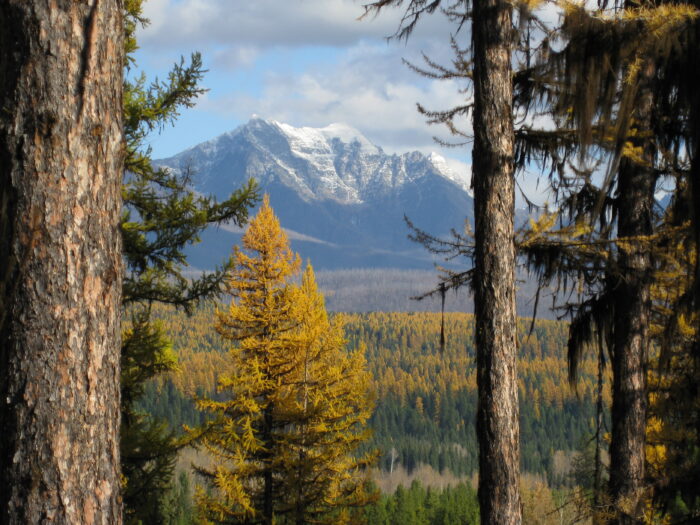
Their 310 acres sit in the heart of the North Fork, between Glacier National Park and the designated roadless area in the Whitefish Range, a wild corridor teeming with elk, moose, wolves, and grizzlies. For Kari, the place has always been captivating. “As a child, being able to explore the river and all the nooks and crannies of the forest, it really captured my heart.”
But loving the land hasn’t always been easy. In the late 1970s, mountain pine beetles swept through the forest, killing the mature lodgepole pine on the property. Logging became unavoidable. “None of us wanted the forest to change,” Allen remembered. “But the beetle didn’t give us any options.”
The loss was painful, but it also sparked renewal. Wildflowers flourished, aspen groves surged back, and wildlife moved into the newly open spaces. “It was heartbreaking to see something you love change like that,” Kari said, “but we realized that it could be different, maybe even better.” Tim, who had seen beetles devastate his own family’s land near Martin City, agreed. “We saw that land management could be very beneficial,” he said. “It changed the whole character of the forest in a good way.”
That experience set them on a new path of stewardship. Allen, a professional forester, brought decades of expertise and designed detailed forest management plans. They keep weeds in check, cut encroaching conifers from aspen groves or meadows, and thin trees along trails to prevent surprise encounters with bears. Other areas are left untouched to provide wildlife with thermal cover and a place to hide.
Tim added a hunter’s eye for wildlife, paying close attention to how animals move across the property. “We have this incredible balance of predator and prey species,” he said. Together, Kari, Allen, and Tim monitor wildlife trails, check cameras, and adjust management strategies to support the health of the forest and the full spectrum of life that depends on it.

Grizzly with yearling cub on the property.
The results of their efforts are remarkable. Trail cameras capture black and grizzly bears rubbing on trees, wolves moving by silently, and countless deer and elk on the move. “I joke that we grow grizzly bears and harvest the occasional lodgepole pine,” Allen laughed, “but in reality, we grow whitetail deer.”
Protecting that wild balance has been an ongoing challenge. In the 1970s, Allen and Kari’s father resisted offers from oil and gas developers. More recently, the increasing subdivision in the North Fork convinced them that their property should never be broken apart. “It was really important to me that the property wasn’t subdivided,” Kari said. Allen agreed: “Compared to the 1960s, it’s remarkable how much development has gone on. We wanted to keep this place whole.”
In 2024, working with Mark Schiltz of The Montana Land Reliance (MLR), the family placed the property under a conservation easement. The easement ensures that their 310 acres will remain wild and intact forever, while still allowing them to actively manage their forest. “The recognition of the value of forest management in keeping ecosystems functioning was a game changer,” said Allen.
For the family, the land is more than just scenery – it’s a place of healing. Kari recalls her parents bringing troubled cousins out to the cabin to reset, giving them projects and space to breathe. “For so many of them, it made a huge difference in their lives,” she said.
Allen remembers his son returning from military deployments overseas and heading straight to the cabin to decompress. “One of the first things he did was sit on the deck with sunflower seeds and feed chipmunks from his hand,” Allen said. “As a father, you’re glad to have a place that does that for your family. This really is our legacy.”
Tim feels the same sense of restoration. “I can go up there after a long stretch of work and just walk into the woods,” he said. “People talk about silence in the forest, but it’s full of sound. It’s just the kind of noise that clears your mind instead of cluttering it.”
Kari’s voice softens as she sums it up: “We’re only on this earth for a short piece of time. It brings tears to my eyes that this is one good thing I’ve actually done. With the easement, this place will always be here for people to discover the magic that happens when you can be in the quiet and just get away from it all.”